martes, 13 de octubre de 2020

Bavaria 1809 Napoleonic Campaign -solo mode- with Cyberboard

I finally decided to carry out the 1809 Bavaria Napoleonic campaign in solo mode, with the help of Cyberboard software, a simple but reliable software that doesn't require much time to invest in.Why Bavaria 1809 campaign? Was the first serious attempt for the Austrian empire to try to crush Napoleon after the defeat of 1805, and saw a series of interesting battles like Aspern-Essling, Eckmühl or finally, Wagram, and the first defeat of the Corsican as French emperor in Aspern. The armies were similar in numbers and had various phases: first an Austrian offensive, and Napoleon through the defensive to offensive.
 
Over the years, I've tried it maps with Berthier software (square based grid), with hexagon boards, with offset squares, but there was always an impediment or another to complete their final design, or maybe it was my lack of consistency. I chose finally a Point-to-Point map (drew with Hexdraw software), because Napoleonic armies marched basically on roads and I think that PtP reflects much better those historic movements. Finally, instead of the classic square counters, flags as units, perhaps it reflects more the atmosphere with those old beautifully drawn Napoleonic maps.


SYNOPSIS:
 
This is a simple mini-campaign that can be played as a quick board game or by solving battles or skirmishes with miniature figures on wargames. The game attempts to simulate the first part of the 1809 campaign between the Austrian and French armies that took place on Bavarian lands, with a player manoeuvring French troops and Austrian actions being automated. The game begins with the Austrian invasion at various points from the east and a single French army corps, the VII, roughly at the centre of the board. 
 
 
THE MAP:

The map of the Point-to-Point campaign is the playing field, showing the area between the populations of Ulm and Passau, about 250 kilometres from West to East, and from Nuremberg to Munich, about 145 kilometres from North to South. The distance between nodes is about 10 kilometres. The main accidents, mountains, rivers and their various tributaries are defined. There are two strong cities that are Ulm and Regensburg. The latter is one of the key objectives of the campaign: the old Regina Castra, established on a site that, as Goethe put it, "was destined to attract a city." It became the capital of the Dukes of Bavaria in 530 d. C. The Imperial Diet met there from 1663 until its dissolution in 1806.


THE COMPONENTS
 
The map is marked with geographic locations and accidents, all located on points also called nodes. French and Austrian counters usually represent divisions grouped in army corps. Austrian decoys are deployed entering Bavarian territory, at different points. We also have a series of event cards that condition the development of the campaign on either side. Decoys and regular units are represented by flags and Corps commanders move with artillery reserve in all cases. About 10 D6 dices to play, more or less. 
 
 
The player screen on Cyberboard: as usual, Game Turns, reinforcements (only French) the weather and Victory points (Moral factor don't count on the final version), and a pile of event cards.


People who had played "Les Marechaux" series from Vae Victis, will know this OOB format of Davout's 3rd French Corps. Both OOB, Austrian and French, are in the same way, Divisions are formed by force points (PF), each representing 1,000 infantry, 500 horsemen or 1 artillery battery. Every Division, Commander in Chief, artillery reserve and supply wagons are represented by a flag on the board, with their National flag and commander.  


THE GAME:

The Austrians always move first, until Napoleon's presence on the board, a moment from which the French will always move first. Each turn represents one day, for a total of 10 campaign turns. On the French side, only the Seventh Bavarian-French Corps of Marshal Lefevbre can place its units within a triangle delimited by the populations of Landshut (II18), Regensburg (HH9) and Donauworth (O14).
Austrian forces (decoys) enter the board at various points: with a 1D6 pull, the entry point is checked, and with a second 1D6 pull the forward points to the starting point, in the following order, from south to north:
1. Burghausen (RR25); 2 Braunau (U23); 3. Schärding (AAA19); 4. Passau (AAA16); 5. Rötz (NN3); 6. Naaburg (II0).
 
Turn 3.
The red Austrian decoys try to conquer Regensburg (north of blue Bavarian units). As in reality, Bavarian light blue forces try to wait French allies and defend the Isar river bridges. The decoys movements are regulated by a 1D6 (initially "6" was a "0", but it was bad for the fluency of the game, and finally "6" and "1" are translated to a minimum of "2" points)


Turn 4. The Austrian decoy "J" with Wrede Bavarian division. Finally, no troops representing this decoy, so it's retired from the board (really, the screen).


THE RULES:

Rulebook of Bavaria 1809 campaign, based on Nic Birt's Agincourt Campaign, published in Lone Warrior #143, and a Napoleonic campaign test from General Nuisance's website. The player controls French troops and Allies, with automated movements for Austrian troops (regular troops and decoys). The mechanics of the battles, based on Altar of Freedom Campaigns from Greg Wagman and the Marshals series from Vae Victis magazine. As you see a "mix" of rulebooks, with 9 pages of homemade rules, in Spanish. If you are interested, please e-mail to am50424@gmail.com.


- - - - - - o - - - - - -


 Over the years, I've tried with Berthier software, with hexagon boards, but there was always an impediment or another to complete their design, or maybe it was a lack of consistency. Over the years, I've tried with Berthier software, with hexagon boards, but there was always an impediment or another to complete their design, or maybe it was a lack of consistency.

sábado, 4 de enero de 2020

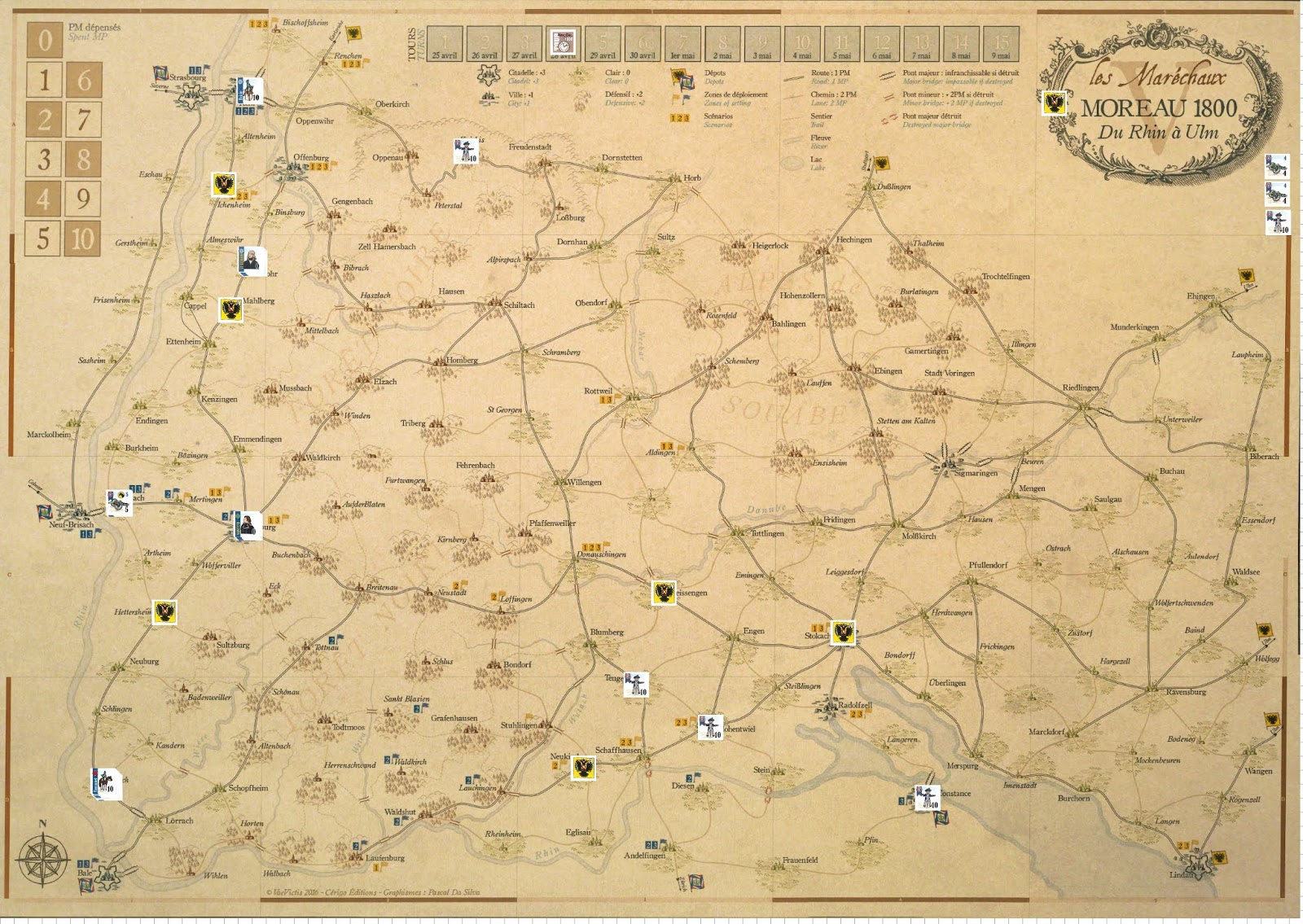
Game "Moreau 1800". La Campagne d'Allemagne, from Vae Victis.


A couple of years ago I bought a copy of the game "Moreau 1800", from Les Maréchaux series by the French Vae Victis, to play it for PBEM with a referee, myself. We started the campaign during 2019, but as usually happens on most occasions, the campaign did not end and only a few turns were played, but I decided to publish it as an example of the game.
We follow generally the rules of the game, except in the case of the Moral and Event rules that were set aside. The scenario we played, the first, The crossing of the Rhine, that describes the beginning of Moreau's campaign as he attempts to gather together his dispersed troops. The Victory conditions, for Austrian player only, control de cities of Kehl, Offenburg, Friburg, Donauschingen, Blumberg, Neukirch and Stokach, being +1 VP per zone.

The scenario is a point-to-point map, a classic from Vae Victis campaigns, and the units are division level grouped in armies or army corps. One player commands the French army, with Saint-Cyr in the center, Sainte-Suzanne in the left-wing, Lecourbe in the right-wing and Moreau in the reserve. The other player commands the Austrian army, with Nauendorf in the center, Sztaray in the right-wing and Reuss in the left-wing.


THE COMPONENTS


The point-to-point map of the campaign. The game has two maps, the other on the reverse side for number 4 to 6 scenarios.


The game counters.


THE CAMPAIGN

TURN 1


Referee map. The flags are the presence of units or decoys. The initial campaign map was in Cyberboard module, but the play was not in Cyberboard, only by pictures, and it was a big mistake, cause it was a great amount of time for me (the referee) to change the flags by units and vice-versa.

Map for Austrian player and movements.

Map for French player and movements.

At this point, it should be noted that each player had two maps: one with the positions of all the units that were used to mark the displacements, and another with the presence of enemy units only two nodes distance, with flags, a circumstance that was not well interpreted by the French player, for example, who sent me the movements with the map of flags, and not with that of units, and it was impossible to know if he wanted to move all units or only specific ones.


An explanation of movements to the referee... (theoretically)  


TURN 2

The referee map for second turn.


TURN 3

The referee map for third turn and a battle in Freiburg area.

The Freiburg area zoomed.


To the left, the numbers, with an MS Excel sheet, and the units involved to the right. Finally, the French player wins by his numerical superiority.


TURN 4

The map for French player in the fourth turn.


This was the last turn we played, one of the players had problems to answer the turns in a reasonable period of time and we decided to finish, two turns before the end of the campaign.


"THE DEUTSCHE TRIBUNE"


I also decided to make a fictitious summary sheet of the campaign, in the old way, to follow the campaign or to give information to the players.


CONCLUSIONS

- Have the same support for players and referees, whether computer or paper.

- Only one map for the players.

- Usually players move the pieces only to try to push the enemy units in front of them, without thinking of a broader operational objective. 

- Next campaign in solitaire mode... (only a joke)  


martes, 20 de agosto de 2019

Juego. Batalla de Mianegas o de Bañolas (23-06-1813)


Como acompañamiento a nuestros artículos que tratan sobre la batalla de Bañolas o Mianegas (23-06-1813) en nuestro blog madre de "El Rincón de Byron",  (http://byroncillo.blogspot.com/2019/08/banolas-y-la-batalla-de-mianegas-1813-i.html), nos hemos decidido a realizar un tablero hexagonal de juego para intentar reproducir la batalla de una manera simple. El mapa está dividido en hexágonos que representan 200 m de lado a lado, con sus unidades correspondientes y que se puede jugar con el reglamento de "Napoleon at Waterloo" de Jim Dunnigan. El orden de batalla lo teneis definido más abajo, por si quereis reproducir la batalla con otro reglamento cualquiera o aprovecha el mapa para cualquier otro enfrentamiento real o hipotético, durante la Guerra de Secesión, las Guerras Carlistas o la Guerra Civil Española.


As an accompaniment to our articles dealing with the battle of Bañolas or Mianegas (06-23-1813) in our mother blog of "El Rincón de Byron", (http://byroncillo.blogspot.com/2019/08/banolas-y-la-batalla-de-mianegas-1813-i.html), we have decided to make a  game board hex based to try to reproduce the battle in a simple way. The map is divided into hexagons that represent 200 m from side to side, with their corresponding units and that can be played with the rules of "Napoleon at Waterloo" game, by Jim Dunnigan. The battle order it's defined below, in case you want to reproduce the battle with any other rules or take advantage of the map for any other real or hypothetical confrontation, during the War of the Spanish Succession, the Carlist Wars or the Spanish Civil War.


Tablero de juego.


TABLERO DE JUEGO / GAMEBOARD:    Gameboard


Unidades españolas y francesas


UNIDADES / COUNTERS:  Counters


ORDEN DE BATALLA / ORDER OF BATTLE


Unidades españolas / Spanish Units
Regimiento de Cazadores de Baza
1 batallón
Regimiento de Fernando VII
1 batallón
Regimiento de Leales Manresanos
1 batallón
Cazadores de Ausona
1 compañía
Húsares de San Narciso
114 jinetes


Total aprox.
2300 bayonetas

114 sables


Unidades francesas / French Units
Regimiento 3e Légère (Bañolas*)
98 hombres
Regimiento 3/23e Ligne
369 hombres
Regimiento 1/60e Ligne
582 hombres
Regimiento 2/60e Ligne
763 hombres
Regimiento Chasseurs de Lampourdan
151 hombres
Regimiento 1/1 de Würzbourg 309 hombres
Regimiento 2/2/29e Chasseur à cheval 94 sables
Regimiento Chasseurs de Lampourdan 37 sables
Artillería Cía 60e Ligne - Bañolas 93 hombres


Total aprox.
2.266 bayonetas

131 sables

93 artilleros

3 cañones
(*) De guarnición en Bañolas [F.M.G.]


- - - - - - o - - - - - -