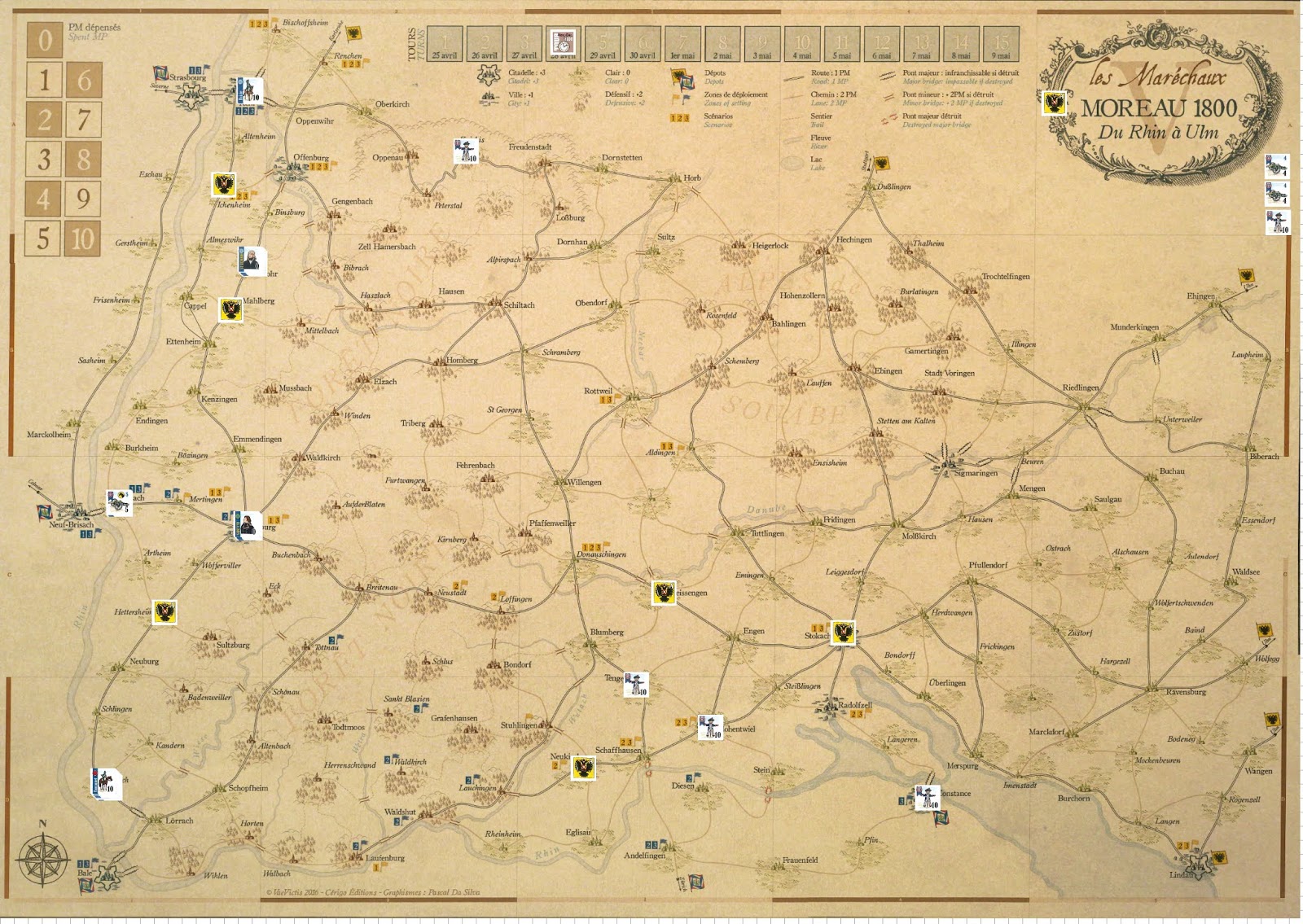
A couple of years ago I bought a copy of the game "Moreau 1800", from Les Maréchaux series by the French Vae Victis, to play it for PBEM with a referee, myself. We started the campaign during 2019, but as usually happens on most occasions, the campaign did not end and only a few turns were played, but I decided to publish it as an example of the game.
We follow generally the rules of the game, except in the case of the Moral and Event rules that were set aside. The scenario we played, the first, The crossing of the Rhine, that describes the beginning of Moreau's campaign as he attempts to gather together his dispersed troops. The Victory conditions, for Austrian player only, control de cities of Kehl, Offenburg, Friburg, Donauschingen, Blumberg, Neukirch and Stokach, being +1 VP per zone.
The scenario is a point-to-point map, a classic from Vae Victis campaigns, and the units are division level grouped in armies or army corps. One player commands the French army, with Saint-Cyr in the center, Sainte-Suzanne in the left-wing, Lecourbe in the right-wing and Moreau in the reserve. The other player commands the Austrian army, with Nauendorf in the center, Sztaray in the right-wing and Reuss in the left-wing.
THE COMPONENTS
 |
| The point-to-point map of the campaign. The game has two maps, the other on the reverse side for number 4 to 6 scenarios. |
 |
| The game counters. |
Referee map. The flags are the presence of units or decoys. The initial
campaign map was in Cyberboard module, but the play was not in
Cyberboard, only by pictures, and it was a big mistake, cause it was a
great amount of time for me (the referee) to change the flags by units
and vice-versa.
 |
| Map for Austrian player and movements. |
 |
| Map for French player and movements. |
At this point, it should be noted that each player had two maps: one with the positions of all the units that were used to mark the displacements, and another with the presence of enemy units only two nodes distance, with flags, a circumstance that was not well interpreted by the French player, for example, who sent me the movements with the map of flags, and not with that of units,
and it was impossible to know if he wanted to move all units or only specific ones.
 |
| An explanation of movements to the referee... (theoretically) | |
TURN 2
 |
| The referee map for second turn. |
TURN 3
 |
| The referee map for third turn and a battle in Freiburg area. |
 |
| The Freiburg area zoomed. |
 |
| To the left, the numbers, with an MS Excel sheet, and the units involved to the right. Finally, the French player wins by his numerical superiority. |
TURN 4
 |
| The map for French player in the fourth turn. |
This was the last turn we played, one of the players had problems to answer the turns in a reasonable period of time and we decided to finish, two turns before the end of the campaign.
"THE DEUTSCHE TRIBUNE"
I also decided to make a fictitious summary sheet of the campaign, in the old way, to follow the campaign or to give information to the players.
CONCLUSIONS
- Have the same support for players and referees, whether computer or paper.
- Only one map for the players.
- Usually
players move the pieces only to try to push the enemy units in front of them, without thinking of a broader operational objective.
- Next campaign in solitaire mode... (only a joke)